Friday, July 28, 2006

Vintage Weekends V

We're just about smack dab in the middle of Summer and chances are your weekends are filled with ways to try and keep cool. But when you need a break from the beach, the pool or have had your fill of BBQ, stop into one of these fantastic exhibits. Museums are always air conditioned!

Bath, England
John Bates: Fashion Designer - July 14, 2006 to August 28, 2006 - Museum of Costume, Bath - A major fashion retrospective of the work of John Bates, who designed under the name Jean Varon from the 1960s to the 1980s, takes place in July and August 2006 at the Museum of Costume.

London, England
Sixties Fashion - June 6, 2006 - February 25, 2007 - Victoria & Albert Museum - This exhibition explores the development of Sixties fashion from the mid-1950s to the early 1970s, linking it to London's different fashion districts and celebrating the contribution made by young British designers to a world-wide fashion revolution.

Phoenix, AZ
Art in Hand - Judith Leiber Handbags - April 22, 2006 - August 27, 2006 - Phoenix Art Museum - Judith Leiber, a leader in couture handbags, has created more than 3,000 different designs in a career that began in 1963, and over 100 of them can be seen in this exhibition. Best known for her signature crystal covered minaudieres – small ornamental cases for a woman's cosmetics, jewelry, or personal items – in the fanciful shapes of animals, fruits or anything that inspires her fancy, Leiber’s handbags also are hailed for their incomparable originality and flawless hand craftsmanship.

Hartford, CT
Revivals: Costumes for Song and Dance - March 11, 2006 - August 13, 2006 - Wadsworth Atheneum Museum of Art - In this exhibition, the word "revival" has a dual meaning: a new production of something old, and the return of original splendor. The new from old is represented by Raoul Pené du Bois' design sketches and costumes for the 1971 Broadway revival of the flapper-era musical comedy No, No, Nanette. The return to original splendor is exemplified by creative restoration techniques used on costumes from Serge Diaghilev's 1921 Ballets Russes production of The Sleeping Princess.

Kent, OH
Oscar de la Renta: American Elegance - May 11, 2006 - May 27, 2007 - Kent State University Museum - The Kent State University Museum has been the recipient of three important gifts from Oscar de la Renta that encompass his career. In 1983 he presented the founders, Shannon Rodgers and Jerry Silverman, with 45 pieces from his Spring 1982 collection. Again in 1986 he presented 38 pieces from the earliest phase of his career beginning with dresses he created for Jane Derby in 1965. In response to a request to lend dresses from a current collection for this exhibition, Oscar de la Renta has given the museum four spectacular pieces from his Spring 2006 collection. The exhibition is drawn from these gifts and those of other donors and spans his career from his arrival in New York in 1963 until the present.

Tuesday, July 25, 2006

Where Does Old Clothing Go?

Article By J.R. Labbe, Star-Telegram Staff Writer

Clothing covered the guestroom bed. Tattered T-shirts, cargo pants with a ripped pocket, shorts that are a smidgen too tight in the waist, men's dress shirts a tad snug in the collar, women's suits that are so last year.

Stained, torn and otherwise tacky threads go to the garbage pile. Everything else gets folded and put into boxes for Goodwill.

What's that you say? Goodwill will take the T-shirt you wore while painting the kitchen and the blue jeans with the inseams pulled apart?

Yup, says David Cox, director of retail sales and marketing for Goodwill Industries of Fort Worth. There's dollars in those rags. Plus a lot of hope.

The United States really is the land of plenty. Our conspicuous consumption leads to embarrassing excess. We discard perfectly good clothing just because it's no longer the latest fashion. About 80 percent of the nation's used textiles ends up in the dump. The other 20 percent is recycled, primarily by charities that make up the majority of the used textile market.

Getting a larger percentage of those old clothes out of the landfill and into a place where they do others some good is a worthy goal. Goodwill Industries and the Salvation Army do what they can to make that as easy as possible, with drop-off boxes and collection centers tied to their thrift stores. But there are new players in town -- for-profit businesses that see dollar signs in the demand for high-quality, low-cost used clothing.

Nothing wrong with that. Free enterprise is the American way. It's just a good idea to do your homework before assuming that all collection boxes are created equal. All clothing drives are not tied to charities that use the proceeds for helping disadvantaged people or families in crisis.

Take U'SAgain, a recycling company that targets the "collection and wholesale of reusable clothes, shoes and household textiles." According to its Web site, last year U'SAgain collected "6,700 tons of textiles, used clothing and shoes, translating into the conservation of 84,000 cubic yards of landfill space."

It's laudable that U'SAgain kept that much stuff out of the waste stream. But reading the company's Web site leaves one with the impression that this is a charitable endeavor, especially since it promotes "fundraising opportunities" for schools and churches willing to host a bin on their property. They would receive $20 to $40 for every ton of material collected onsite. The industry standard for the value of textile waste is a minimum of $100 per ton.

There's also some confusion about what Goodwill does with its donated clothing. Witness the questions that George Kessinger, CEO and president of Goodwill Industries International, was asked before he spoke at my Rotary Club: Is it true that the majority of clothing given to Goodwill is shipped overseas? That it doesn't go to people who need clothing but to companies that shred it for rags?

Yes and no.

Goodwill has two lines of salvage, said Cox. Textile that is unusable when donated because it's torn or stained is bundled into 1,000-pound bales and sold to salvage graders, who export it for industrial purposes -- rags, stuffing in furniture.

Trans-Americas Trading Co. is one such processor of secondhand clothing, vintage/fashion clothing, wiping rags, fiber and textiles. The Brooklyn, N.Y.-based company estimates that 2.5 million pounds of unwanted clothing are recycled annually by companies such as Trans-Americas and charitable institutions such as Goodwill.

That's only 20 percent of all textile waste.

Usable clothing is displayed in Goodwill's retail stores for sale, but as at any retail operation, the merchandise has to change on a regular basis to keep folks coming back. "We go to every measure possible to sell what is donated to us in our stores, but we do have a five-week rotation," Cox said. "If it doesn't sell in that time, we bale it by pound, but we get a higher dollar amount for it because it's usable clothing."

Trans-Americas says that eight out of 10 pounds of clothing collected by large charitable institutions end up sold to recyclers.

Some of the clothing is exported intact to countries where last season's American fashions are very desirable.

"A young woman in another country can flip through the pages of a fashion magazine to see the latest styles," Kessinger said, "and find something from the clothing that American women have discarded."

Kessinger mentioned that some countries limit used clothing imports because they compete with domestic textile production. South Africa, for example, bans the import of worn clothing except for humanitarian purposes.

Whether the Goodwill proceeds come from retail store sales or salvagers who ship the textile overseas, the money supports the training and educational programs that Goodwill offers for people with disabilities so they can become self-sufficient members of society. And Cox is proud to point out that 90 cents of every dollar that Goodwill receives goes back into the mission.

"We have two options," said Cox. "Throw it away and it goes to the landfill, or reap some benefit from it with profit that supports our mission. We choose to be an eco-minded organization and get some profit and benefit to support our mission."

Monday, July 24, 2006

Bringing Back the Beauty

Article By MICHAEL FORTUNA, DAILY SUN

Caryn Krisha gets to wear her collection.

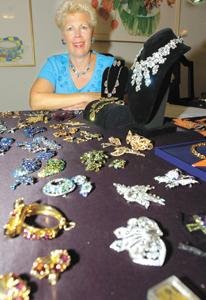
Just about every day, Krisha puts on some of her vintage costume jewelry from the 1940s to the 1970s.

“When I worked everyday, this was my trademark,” Krisha said. “There are people who don’t remember me, but remember the jewelry.”

For the past 10 years, Krisha has collected numerous brooches, bracelets, necklaces, and earrings of various sizes, colors, and shapes; some of the pieces come in different hues. They are made by such companies as Weiss, Regency, Kramer, Hollycraft, Florenza, Schreiner and Miriam Haskell.

“Each one is unique and each one is different,” Krisha said. “It’s a great hobby because it’s small.”

One of her favorite pieces is a large silvery necklace with many clusters of dangling stones.


“They’re all my favorites,” Krisha said. “When I wear it, it’s my favorite.”

The collection began when she received several pieces from her grandmother and mother, including one that featured her mother’s birthstone in the center. Krisha also has Austrian pins in the shape of pears and cherries that she bought when she was younger.

“I kept all my jewelry since I was a child,” Krisha said.

She started seriously collecting jewelry about 10 years ago.

“At first, you buy what you like,” she said. “When you get to my stage, you get more selective.”

Krisha, who was a member of the Houston Vintage Jewelry Club in Texas, finds jewelry at such places as antique shops, flea markets, the Internet auction site eBay, and estate sales. She also travels to the Vintage Fashion and Costume Jewelry national convention in Rhode Island.

“We wear vintage clothes,” Krisha said. “It’s fun, like being little kids again.”

The national group has several criteria for determining if a jewelry piece is welcomed into a collection, including craftsmanship, condition, color, size, demand/rarity, and price.

Krisha uses a true color light to make sure the jewelry matches the color of the clothing that she is wearing.

Sometimes the jewelry set isn’t complete, and Krisha might stumble upon the missing piece during another shopping excursion.

“Not everything is pieced together,” Krisha said. “That’s the thrill of the hunt. If I find a pin, I’ll know there are earrings that go with the pin.”

To aid in her quest, Krisha has several jewelry reference books that feature photographs and histories behind the pieces.

“I can sit and look at the pictures,” Krisha said. “Maybe you didn’t know it has a set until you see it (in a book).”

Wherever she goes, she keeps her eyes open for jewelry pieces to add to her collection.

“It’s in my blood,” she said.

Tuesday, July 04, 2006

Alfred Shaheen


Alfred Shaheen is one of the best known of the Hawaiian garment and textile designers of the 20th Century. Shaheen was active from the 1950s into the 80s, but he is best known for his work in the 50s. His handprinted textiles were based on the flora and fauna of the Hawaiian Islands, along with Hawaiian traditions amd authentic tapa cloth designs.

Shaheen produced not only the fabric, but they also manufactured clothing made from it. Shaheen was known for their sexy sarong dresses and swim suits, Hawaiian shirts and halter dresses with full skirts.


Above bio courtesy of the VFG Label Resource. To read more about Alfred Shaheen check out the official website here.

And this week, VFG member Linda of The Vintage Clothes-Line has this spectacular vintage beauty shown in our photos from Alfred Shaheen up for auction.

It's not often a gem like this comes up for grabs - and especially in such a wearable size. If it fits your fancy and your body, we suggest you treat yourself and tell Linda we sent you!